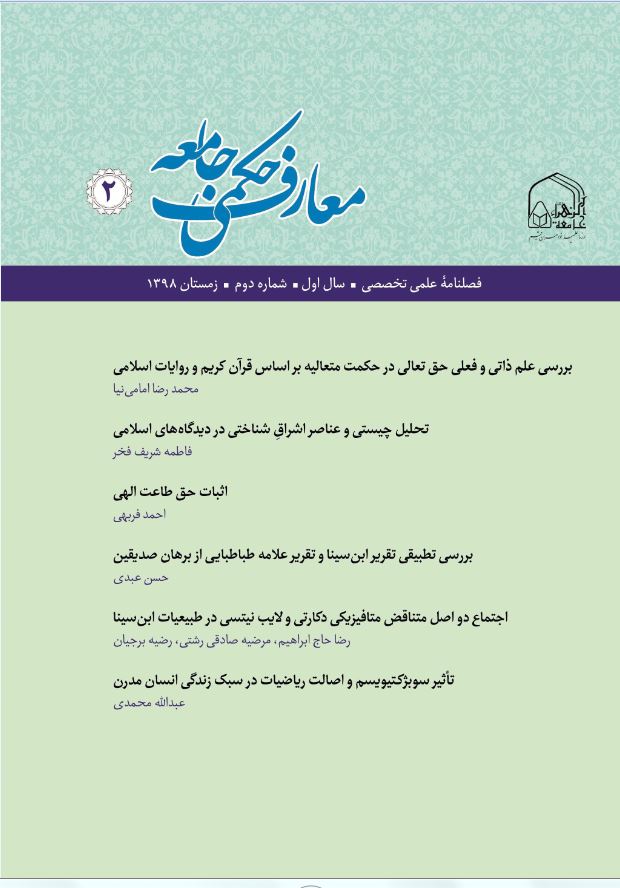
Anthropological views are considered the most basic and influential views of philosophers in any philosophical system; Because the goal of philosophy is nothing but the perfection of man in his theoretic and practical course. Sadra's anthropological model - with its fundamental differences from the previous models, based on principles such as: originality of existence, gradual state of existence, ascendant existential movement and the union of the learned and the known - declares that the human soul is a physical, dynamic, moving and - the most important thing - It is self-made and willful. In such an approach, humans are a “single species” based solely on their original nature, and “thoughtful animal” is considered to be the common material of human kinds. The resulting part of this “substantial” meaning and originator of “special type” is "Nafs (Self)". The main materials that make up and weave the Nafs in different levels of existence are its perceptions, structures and habits. According to Mulla Sadra, due to the difference in perceptions and habits of different people, the difference between human beings’ Selves is an essential and inherent difference, and according to the second nature, humans will have different types and kinds. In this article, while examining Sadra's point of view about the Nafs and the type plurality of the human selves, we have explained and analyzed some of its important anthropological and eschatological consequences; Among them: the rational justification of self-improvement and self-care, multiplicity and difference of moral prescriptions for educating people according to the movement path of their Nafs, the basis of the habits for the truth and human personality as well as his afterlife face, the difficulty of repentance and changing the habits, the variety of paths with regard to unity of the way and voyager, the multiplicity of evaluators in proportional to the existential personality of people, the multiplicity of heaven and hell in proportional to the firm habits of people, etc. Paying attention to the principles of Sadra's psychology and considering their coherence and consistency will show the power of explanation, justification and response of this intellectual system to many ambiguous issues about the Self.
Kawndi, S. (2022). The anthropological and eschatological implications of Sadr al-Mutaalehin's view about the Self. Judicial Knowledge of Society, 3(5), 23–52.
MLA
Kawndi, S. "The anthropological and eschatological implications of Sadr al-Mutaalehin's view about the Self", Judicial Knowledge of Society, 3, 5, 2022, 23–52.
HARVARD
Kawndi, S. (2022). 'The anthropological and eschatological implications of Sadr al-Mutaalehin's view about the Self', Judicial Knowledge of Society, 3(5), pp. 23–52.
CHICAGO
Kawndi, S., "The anthropological and eschatological implications of Sadr al-Mutaalehin's view about the Self." Judicial Knowledge of Society, 3 5 (2022): 23–52,
VANCOUVER
Kawndi S. The anthropological and eschatological implications of Sadr al-Mutaalehin's view about the Self. Judicial Knowledge of Society. 2022;3(5):23–52 (In Persian).