A Level 4 (Ph.D.) in Transcendent Philosophy (Hikmat-e Mutaʿālīyah), Qom, Iran
Abstract
Hume's systematic critique of the Design Argument posits that the ordered nature of the universe merely suggests a possible resemblance between Divine wisdom and human reason but does not prove anything beyond this. According to him, a rational interpretation of natural order cannot serve as a basis for proving the existence of God or a designer of the universe. His well-reasoned critique challenged the simplest and most common path to proving God's existence and, in his view, entirely dismissed rational theism from the discourse. This critique necessitated appropriate and adequate responses to prevent the general public from rejecting theism and leaning toward materialism. Consequently, many Muslim and non-Muslim thinkers addressed Hume’s objections. This study employs an analytical-descriptive method to examine and respond to some of these objections. It concludes that by not adhering to Hume’s foundational assumptions, many of these objections are fundamentally baseless and illusory. Furthermore, by permitting the use of rational argumentation, accepting order as a valid analogy becomes beneficial, thereby addressing the remaining objections. In this way, the purpose [and validity] of the Design Argument are clarified.
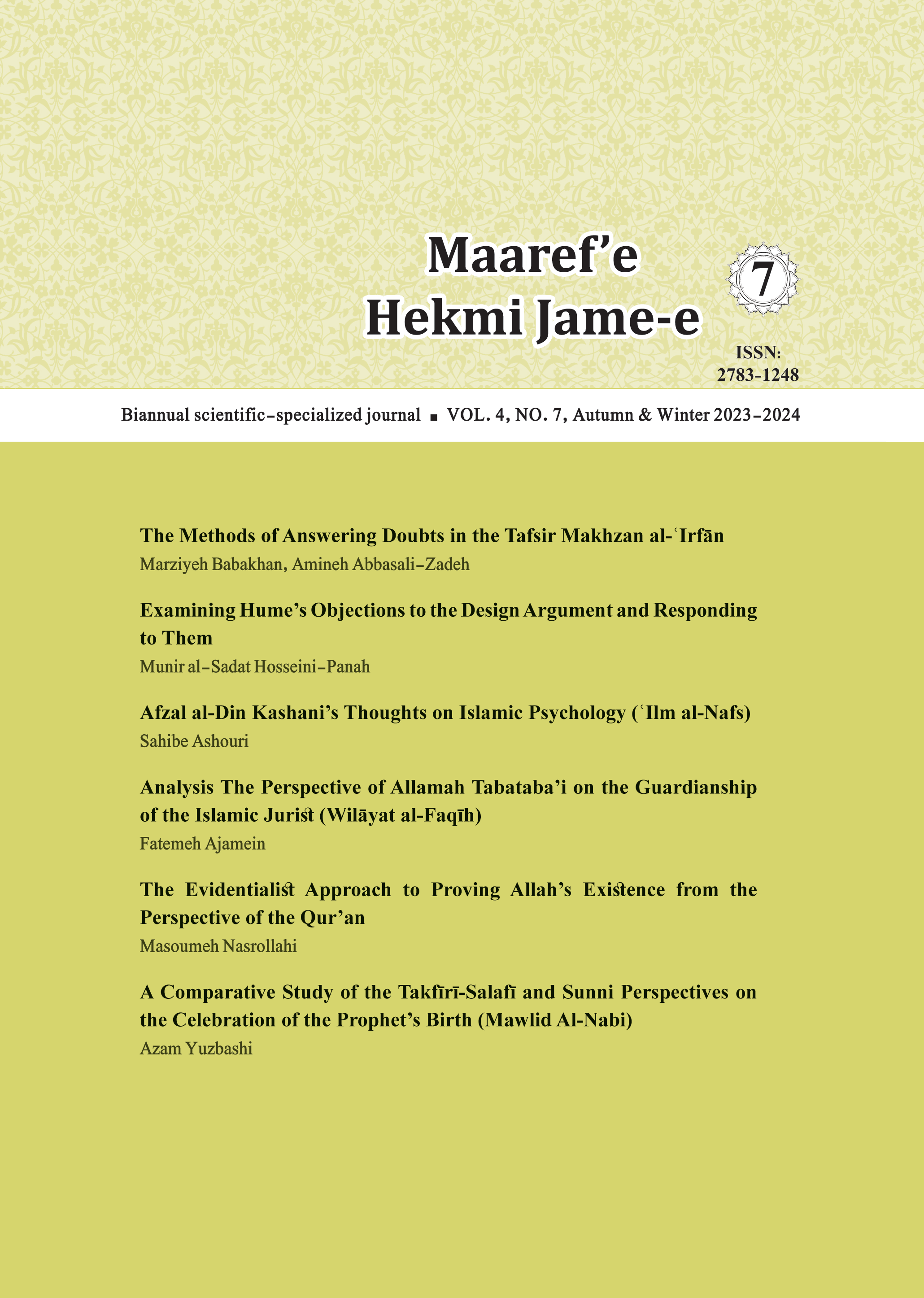
Hosseini-Panah, M. A. (2025). Examining Hume’s Objections to the Design Argument and Responding to Them. Judicial Knowledge of Society, 4(7), 21–44.
MLA
Hosseini-Panah, M. A. "Examining Hume’s Objections to the Design Argument and Responding to Them", Judicial Knowledge of Society, 4, 7, 2025, 21–44.
HARVARD
Hosseini-Panah, M. A. (2025). 'Examining Hume’s Objections to the Design Argument and Responding to Them', Judicial Knowledge of Society, 4(7), pp. 21–44.
CHICAGO
Hosseini-Panah, M. A., "Examining Hume’s Objections to the Design Argument and Responding to Them." Judicial Knowledge of Society, 4 7 (2025): 21–44,
VANCOUVER
Hosseini-Panah M. A. Examining Hume’s Objections to the Design Argument and Responding to Them. Judicial Knowledge of Society. 2025;4(7):21–44 (In Persian).